
Why Physical AI Is the Skill That Matters Now
Software AI is everywhere. Physical AI — intelligence embedded in hardware that acts in the real world — is where the next wave of opportunity sits.
Everyone can call an API now. A generation of students has grown up in an era where a working software demo is a weekend's effort: models are a request away, deployment is a click, and the tooling does most of the heavy lifting. That accessibility is genuinely good — and it has quietly moved the differentiation somewhere else.
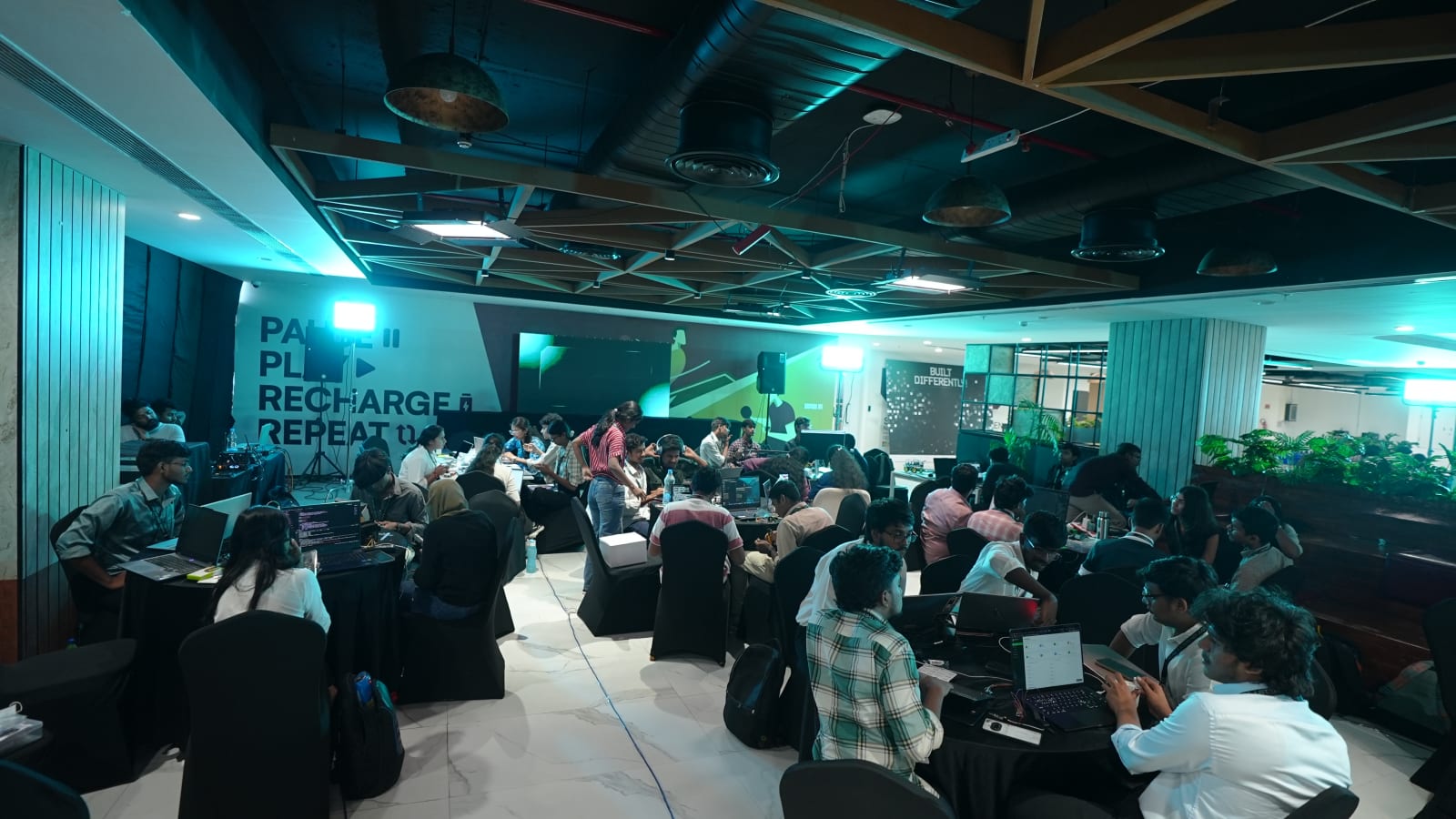
The differentiating skill now is making intelligence work in the physical world — where sensors are noisy, power is limited, latency is real, and failure has consequences beyond an error message. That's Physical AI: machine learning embedded in hardware that perceives, decides, and acts in real environments. It's the discipline behind autonomous drones, precision agriculture systems, medical devices, industrial safety hardware, and disaster-response robotics — and it's the entire premise of Makers Conclave at TakeOver 2026, where 200 students from 14 campuses are spending three days building it, live, on the KKH expo floor.
Why Physical AI is genuinely harder
Students discover the difficulty fast on a build floor, usually within the first few hours. The failure modes are unlike anything pure software prepares you for.
A model that performs beautifully in a notebook fails when the camera fogs, the battery sags under motor load, or the servo jitters at exactly the frequency that corrupts the sensor reading. The training data was clean; the world isn't. Lighting changes, temperatures drift, vibration introduces noise, and the elegant accuracy figure from the validation set quietly collapses in the field.
Debugging spans four layers simultaneously: mechanics, electronics, firmware, and the model itself. A symptom at one layer routinely has its cause at another — the "software bug" turns out to be a grounding issue; the "sensor failure" is actually a timing problem in the firmware. Software engineers debug in one dimension; Physical AI engineers debug in four, and the layers interact.
Resources are unforgiving. On-device inference means model optimisation isn't optional polish, it's survival — the network must run in milliseconds on constrained hardware with a power budget measured in milliamps. There is no autoscaling in a battery.
And mistakes are physical. There is no undo button on a soldered joint, no version control on a stripped screw thread, no rollback for a burnt motor driver. Iteration costs real time and real parts, which forces a planning discipline that infinite-retry software environments never demand.
Why this is exactly what to learn at 18
It's tempting to conclude from all that difficulty that Physical AI is something to attempt later, after mastering software. The opposite is true, and Makers Conclave is built on the opposite bet.
Students who carry a project from breadboard to working deployment develop a kind of engineering judgment that pure software work rarely forces: respect for tolerances, instinct for failure modes, the habit of asking "what breaks first?" before asking "what feature next?" That judgment transfers everywhere — including back into software, where the best engineers are consistently the ones who understand the full stack down to the physics.
There's also a market logic. As pure software capability commoditises, the engineers who can bridge the digital and physical — who can make a model actually run on a device, in the field, reliably — become scarcer relative to demand. Robotics, IoT, med-tech, agritech, industrial automation, and defence are all hiring for exactly this bridge. A 19-year-old with a deployed hardware project has a portfolio artifact that most graduates never acquire.
National platforms are moving the same direction. The Smart India Hackathon increasingly rewards end-to-end capability — working hardware, demonstrated live, solving a real problem — over polished concepts. Building a pipeline from student builds toward those competitions is one of Makers Conclave's stated objectives, with a concrete target attached: at least ten projects from this week assessed as strong enough to develop further and pursue nationally.
The skill stack Physical AI actually builds
It's worth being concrete about what a student acquires across a build like this week's, because "hardware skills" undersells it badly.
At the base: electronics fundamentals that survive contact with reality — power budgeting, signal integrity, why the ground plane matters. Above that: embedded systems — making constrained processors do real-time work, managing memory and interrupts, debugging without the comfort of a stack trace. Above that: the machine learning layer under constraint — model compression, quantisation, the discipline of trading accuracy against latency and power because the device forces the trade. Above that: systems integration — the invisible fourth discipline where most projects die, because the sensor, the firmware, the model, and the mechanics all work individually and fail together.
And capping the stack: demonstration engineering — the ability to make a system perform reliably at a specific moment in front of an audience, which is its own skill involving margin, rehearsal, and failure recovery, and which Saturday's live judging format deliberately tests.
No single course teaches that stack, because it isn't a syllabus — it's a sequence of forced encounters with reality, each layer's lessons only available once the previous layer's illusions have broken. A three-day build compresses those encounters. That's the actual pedagogy of Makers Conclave: not instruction, but engineered collision with the physical world, with mentors standing by to make each collision instructive rather than fatal.
What the floor proves
The six domains represented at this week's build — health, agriculture, safety and transport, disaster response, environment, and smart systems — are not a random spread. They're the domains where India's problems are physical: crops that need monitoring, roads that need to be safer, water that needs testing, patients who need affordable devices. Software alone doesn't touch these; instrumented, intelligent hardware does.
Several projects on this floor have already been deployed in real-world conditions, which is the strongest possible counter to the assumption that serious hardware is beyond undergraduates. It isn't beyond them. It's just harder — and the difficulty is precisely the value.
The distinction that matters
There's a version of engineering education where Physical AI is a lecture topic: slides about sensor fusion, a diagram of an inference pipeline, an exam question about edge computing. And there's the version happening on the KKH expo floor this week, where a team's sensor-fusion approach either stabilises their prototype or doesn't, in front of them, today — and will either survive a live demonstration in front of an industry jury on Saturday or fail in public.
The 200 students at Makers Conclave aren't studying Physical AI. They're doing it — under time pressure, at national-competition standard, with real consequences for real decisions. That distinction between studying and doing is the entire reason the event exists, and it's why the skill they're building this week is the one that will still be differentiating when today's software tooling is table stakes.
The build continues through Friday. Saturday, the physical world gets its vote.